


About This File
Tonight, on a very special
Let's Put Things On Cabinets That Were Never Meant To Be On Cabinets!
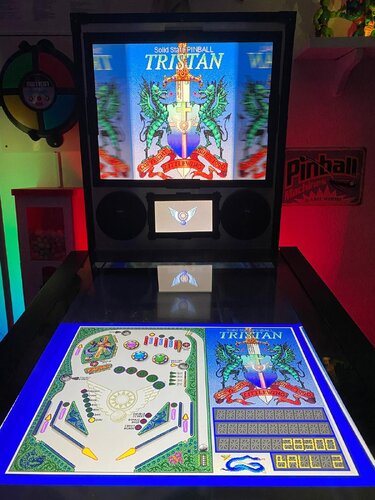
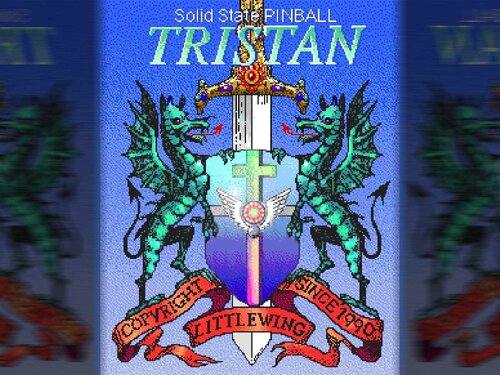
we're still tackling the pinball games of Japanese studio LittleWing. Having already dragged both Crystal Caliburn and Golden Logres kicking and screaming onto my cabinet, I felt it only fair, for completeness' sake, to go all the way back and round out LittleWing's Arthurian trilogy with Tristan, their very first game.
Now Tristan was released in 1991, which means the PC version ran under MS-DOS, which makes it both easier and harder to run on a modern cabinet.
Easier, because we don't need to worry about compatibility modes, obsolete graphics drivers and such - and harder, because we're going to need DOSBox, which can be a bit of a hurdle to set up. I've done my best to make things as easy as possible for you though. You'll find details below under "How to run it".
I'll be honest: Tristan is not much fun to play these days. I can handle the spartan graphics, but the near-absent sound and especially the wonky physics make it a chore. Back in 1991, it won accolades all over the place, but you have to remember that this was just before Pinball Dreams and the like kicked off a wave of more advanced pinball sims with better physics and more flashy presentation. Competition was still very rare, especially on the action-game-starved Mac. (I've seen videos of the Macintosh versions of the game, and it does run a little bit smoother that the MS-DOS version, but not much.) Anyway, take it for what it is.
The included AutoHotKey script rotates the playfield to portrait mode, lowers the resolution to 1024x1280, fills the backglass and DMD screens with decorative images, launches DOSBox (and thus Tristan) and maps the keys to standard cabinet buttons.
I've included
- the AutoHotKey launch script, fully annotated (please go through it and adapt the variables to your system before running it!)
- a DOSBox CONF file for configuration - see further below under "How to run it"
- Tristan's CFG file for sound and graphics configuration - see further below under "How to run it"
- a DMD filler image for in-game purposes
- a backglass image (also usable for your frontend of choice), in both 4:3 and 16:9 formats
Also, tons of frontend media:
- 4 flyer images (images of the packaging and two ad pages from PC magazines of the time - courtesy of MobyGames)
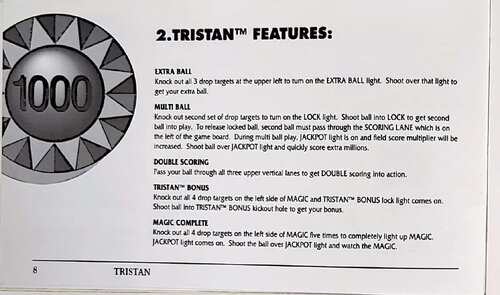
- 10 instruction cards (taken from a scan of the manual)
- table audio (recorded directly from the game)
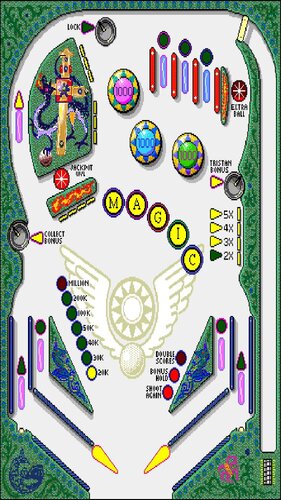
- table image (an upscale of the playfield)
- company logo (taken from Crystal Caliburn's official PDF guide)
- two wheel logos - pick the one you like better.
Share and enjoy!
SOME MORE NOTES:
Where to get it:
This is the only LittleWing game that's not available on their website. A quick Google search should point you towards the usual suspects, though. If your version demands an unlock code at the beginning, just browse any Archive that's reasonably well Organized. If it's not there, it's nowhere, man 😉
How to run it:
Here's where it gets technical, but only a little.
- Get DOSBox Staging at https://www.dosbox-staging.org/releases/windows/, download and install it anywhere. You don't need to setup anything else, all the rest should be configured by the CONF file included in this media pack.
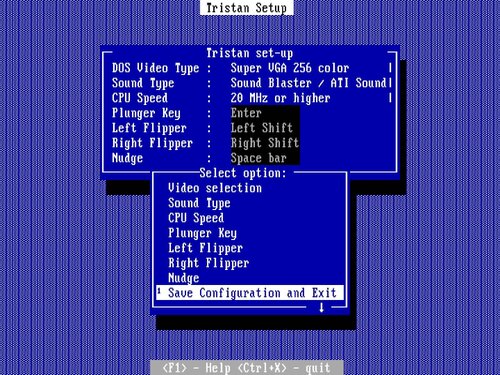
- Drop the file "TRISTAN.CFG" into the folder where your MS-DOS copy of Tristan is. There is likely already a TRISTAN.CFG in there - just copy over it. (It's Tristan's native MS-DOS configuration that tells the game to run in 256 colors with SoundBlaster sound, with Shift keys for flippers, Enter to Launch and Space to nudge.)
- Test it to see if Tristan runs. Simply start DOSBox and type "mount c [whatever folder you put Tristan in]", for example "mount c c:\games\Tristan". This will tell DOSBox to handle the folder as if it were the C-drive. Then type "c:" to change to the mounted drive and type "Tristan" to run the game. You should see the LittleWing Logo and hear a fanfare. Wait until the game loads, press a key to show the menu, select the ESC icon to the left and press Enter. The game should quit and you can type "exit" to leave DOSBox.
- Drop the file "dosbox-staging-Tristan.conf" into the same Tristan folder. The included AutoHotKey script will later launch DOSBox with the configuration in that CONF file. If you look at the end of the file, you will see that it does pretty much what we just did in step 3. NOTE: If you put your MS-DOS files for Tristan in another folder than c:\games\Tristan, you will need to change the line "mount c c:\Games\Tristan" near the end of the CONF file to match your own folder!
- In the AutoHotKey script, please make sure to also adapt the folders under the "Game folder and name" heading. The values for name_of_dosbox_exe and name_of_dosbox_conf probably don't need to be changed; the values for folder_of_game and folder_of_dosbox almost certainly will.
- If you look through the AutoHotKey script, you will see that it also relies on three small helper applications to rotate the screen, to set the resolution, and to display the Backglass and DMD image. Download links are in the script. Please note that their locations also need to be set, under the "Helper apps folders" heading.
- If the game should appear on the wrong screen (i.e. not the playfield) after launching the AHK script, you need to change the monitor number in the dosbox-staging-Tristan.conf. Where it says "display = 0", change the number.
- Once everything is running, compile the AHK script and add it to your frontend of choice.
- Please let me know in the comments section if something isn't working.
Fun nerdy discovery:
All other LittleWing games credit programmer Yoshikatsu Fujita and artist Reiko F. Nojima, but for some reason, Tristan's manual has the programmer as "G. Snowman" and the artist as "Luna Frost".
At first I was disappointed, thinking that I stumbled across the only game not made by the the husband-and-wife LittleWing founders. But then... hang on a minute, Snowman and Frost - that's a bit conspicuous, isn't it?
Then I realized that I'd come across the name "Luna" a lot recently: It was one of the default names in every highscore table when I tested Crystal Caliburn, Loony Labyrinth, Angel Egg and Golden Logres!
Also, the player's guide for one of LittleWing's later games, 2004's Monster Fair, includes the credit "Voices: Snowman & Luna". And finally: Guess who can be found at the very bottom of the online highscore table for 2002's Jinni Zeala on the orphaned LittleWing website, both with a measly 5 million points? Yep, "G. Snowman" and "Luna Frost".
I think it's safe to say that "Luna Frost" is Reiko F. Nojima and "G. Snowman" is Yoshikatsu Fujita, and for whatever reason their first game was not released under their real names. Whether it was by choice or whether Tristan's publisher Amtex felt the American market might not accept games with Japanese origins remains unclear, but it's obvious their nomes de plume stuck around and got reused afterwards for years to come.
AI use disclaimer:
No AI used for this one. I decided to lean into the pixelly goodness this time and didn't smooth out anything.
Edited by SixOfTwelve
Formatting & typos

User Feedback
Create an account or sign in to leave a review
You need to be a member in order to leave a review
Create an account
Sign up for a new account in our community. It's easy!
Register a new accountSign in
Already have an account? Sign in here.
Sign In NowThere are no reviews to display.